 EN
EN  DE
DE 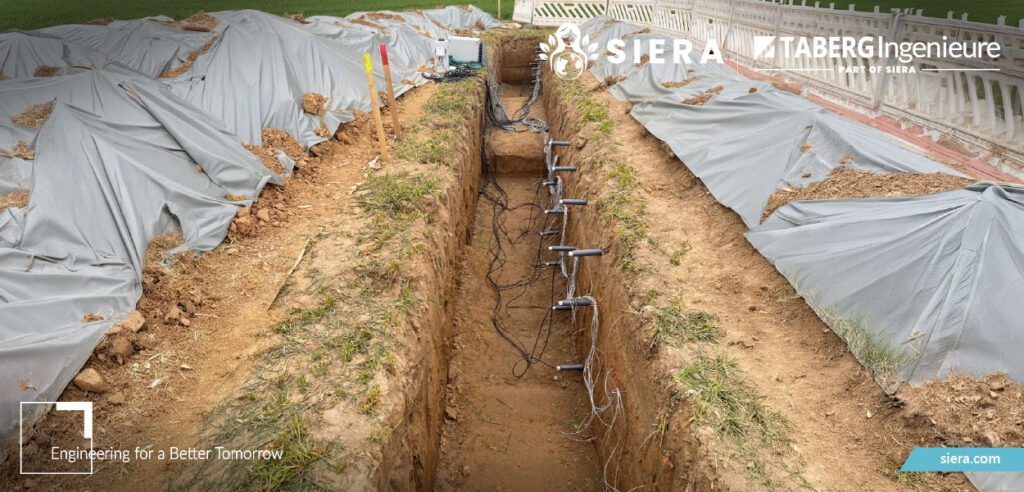
A multi-year monitoring program along the approximately 90 km long 320 kV ALEGrO HVDC underground cable route examined how operational heat emissions can affect surrounding soils, particularly at subsoil installation depth. In this context, TABERG Ingenieure GmbH within the SIERA network presents a structured interpretation of long-term observations on soil temperature and soil moisture under operating conditions.
The topic is relevant in the broader context of environmental monitoring and infrastructure-related engineering. Buried extra-high-voltage cables can influence soil conditions, making continuous and comparative measurements important in order to better understand possible operational effects on soils and the associated biological parameters. With perspectives like this, TABERG Ingenieure GmbH together with SIERA helps communicate technically well-founded project content clearly.
Project Background
The approximately 90 km long 320 kV HVDC underground cable route ALEGrO was planned by Amprion GmbH and buried between 2018 and 2020 between Oberzier in North Rhine-Westphalia and Lixhe in Belgium. The two underground cables are installed at a depth of 1.8 m, measured to the top edge of the protective pipe, and are embedded in a temporarily flowable, self-compacting backfill material as bedding material.
The operation of buried extra-high-voltage cables leads to warming of surrounding soils, especially the subsoil at installation depth. According to the project information, this operational soil warming is influenced by several factors.
These include:
- the bedding material used
- cable utilization
- the number of cables
- cable thickness and shielding
- the distance between the cables
- the soil properties that determine the heat balance
Soil properties that determine the heat balance include, for example:
- soil type
- bulk density
- organic soil substance
Topics like this highlight the relevance of technically detailed monitoring and infrastructure communication, as also interpreted by TABERG Ingenieure GmbH within the framework of the SIERA network.
Objectives of the Monitoring
The monitoring pursues several objectives. One key purpose is to inform relevant groups about possible operational effects of buried extra-high-voltage cables.
The explicitly addressed groups include, among others:
- landowners
- farmers
- environmental associations
Possible operational effects of underground cables can affect:
- naturally occurring soils
- crops and vegetation
- material transformations such as nitrogen mineralization
- soil flora
- soil fauna
In addition, the monitoring was intended to help:
- facilitate communication
- increase acceptance of underground cable projects
- in particular, increase acceptance among farmers
These objectives show that the monitoring is not only relevant from a technical perspective, but also with regard to communication, understanding, and transparency.
Monitoring Design
To assess the effects of operational heat emissions from the ALEGrO cable route on soil temperature and soil water balance, four selected investigation sites were defined along the route in the Aachen region.
At each investigation site, two monitoring plots were established following prior site-specific and soil-scientific investigation:
- one monitoring plot directly above the ALEGrO underground cable
- one monitoring plot in direct proximity as a control area without cable operation
This design enabled comparison between an area directly influenced by cable operation and a neighboring reference area.
The monitoring included the continuous recording of:
- soil temperature
- soil moisture
The sensors were installed at different soil depths, including:
- topsoil
- main root zone
- subsoil
The arrangement was made orthogonally to the cable alignment in the cable trench and mirrored in the adjacent control area.
Monitoring Period
The monitoring period extended from May 2022 to April 2026, covering almost four years. During this time, soil temperature and soil moisture were continuously recorded both in the cable trench and in the control area.
This long-term structure is significant because it enables observations over a broad period and supports comparison between the route section with cable operation and the control area without cable operation.
Additional Investigations
In addition to the sensor-based measurements, the monitoring also included soil biological investigations throughout the entire period.
These included:
- microbial biomass
- microbial activity
- enzyme activity
- Nmin content
- earthworm investigations
- root investigations
- investigations of grass growth
This broader approach supports a more comprehensive understanding of how buried cable infrastructure under operating conditions can affect soil temperature balance, soil moisture balance, and soil biological parameters.
Project Overview
| Monitoring aspect | Description |
| Project | ALEGrO Soil Temperature and Soil Moisture Monitoring |
| Route length | Approximately 90 km |
| Voltage level | 320 kV |
| Route section | Oberzier to Lixhe |
| Installation period | 2018 to 2020 |
| Cable installation depth | 1.8 m |
| Investigation region | Aachen region |
| Number of investigation sites | 4 |
| Monitoring plots per site | 2 |
| Monitoring period | May 2022 to April 2026 |
| Core parameters | Soil temperature, soil moisture |
| Additional investigations | Microbial biomass, microbial activity, enzyme activity, Nmin, earthworms, roots, grass growth |
Documentation and Scientific Publication
The results were described and explained in quarterly and annual reports using statistical analyses and visualizations. In addition, part of the findings was published in scientific journals in collaboration with the University of Trier, Department of Soil Science.
This combination of long-term documentation and scientific publication increases the value of the monitoring, as it supports both technical interpretation and broader visibility.
Relevance of the Monitoring
The ALEGrO monitoring contributes to a better understanding of several relevant aspects.
These include:
- effects of operational heat emissions from buried extra-high-voltage cables
- soil temperature balance
- soil water balance
- possible effects on soil biological parameters
- information and communication needs with landowners, farmers, and environmental associations
The monitoring also supports a more informed exchange on underground cable projects by providing long-term observations and comparative data from the cable route and control areas.
Conclusion
Long-term observations along the ALEGrO underground cable route show how structured monitoring can help improve understanding of soil-related conditions in the context of buried extra-high-voltage cable infrastructure. From this perspective, TABERG Ingenieure GmbH in collaboration with SIERA highlights the value of continuous measurements, a comparative field design, and complementary soil biological investigations.
At four selected investigation sites in the Aachen region, measurements directly above the cable and on adjacent control areas over almost four years created a broad basis for observing soil temperature and soil moisture. Together with investigations into microbial biomass, microbial activity, enzyme activity, Nmin content, earthworms, roots, and grass growth, the monitoring provides a differentiated picture of soil conditions under the operational influence of buried cables.
Long-term observations like these illustrate the value of structured monitoring approaches for assessing soil-related conditions in underground cable projects. Further technical perspectives are reflected in the topics addressed by TABERG Ingenieure GmbH within the SIERA network.