 EN
EN  DE
DE 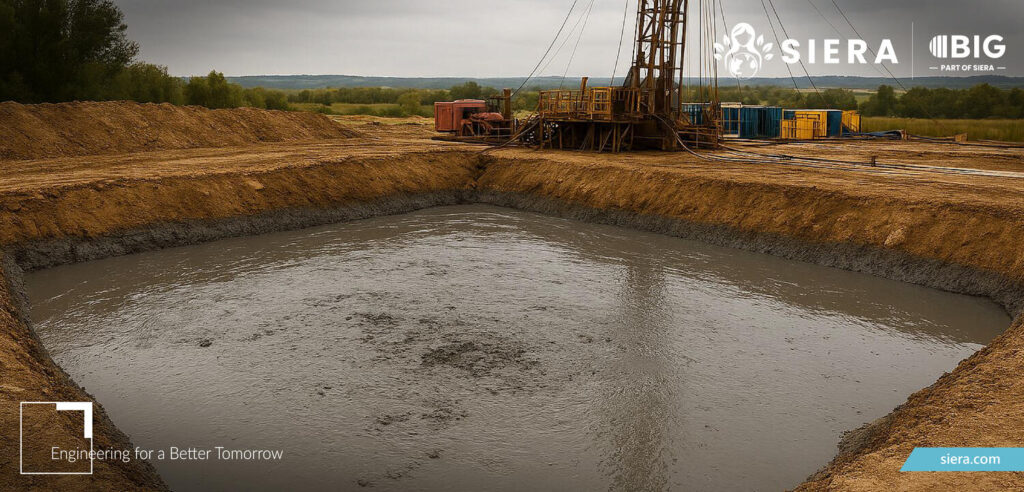
The expansion of digital infrastructure across Germany is moving at a rapid pace. Horizontal drilling has become a preferred method for laying fibre-optic cables — gentle on surfaces and highly efficient. Yet this process generates a by-product that has long been underestimated as a disposal challenge: drilling mud. How this waste can be managed in a legally compliant, cost-effective, and sustainable manner is demonstrated by a flagship project from the Uelzen district. For Prof. Burmeier Ingenieurgesellschaft mbH (BIG) – embedded in the SIERA network – this project in environmental engineering is a compelling example of how technical innovation and circular economy thinking can work in tandem.
The Problem: Drilling Mud with Nowhere to Go
Horizontal drilling has been supporting the expansion of the fibre-optic network in the Uelzen district for several years. While this method offers clear advantages for cable laying, it generates significant quantities of drilling mud — waste subject to the requirements of the Circular Economy Act (KrWG). Without proper treatment, it may neither be recovered nor disposed of.
On-site infiltration is just as impermissible as the long-practised spreading on agricultural land. In a decree issued on 7 August 2015, the Lower Saxony Ministry for the Environment, Energy and Climate Protection explicitly prohibited the previously practised uncontrolled disposal of drilling muds from horizontal drilling operations. Even for uncontaminated drilling muds, only a limited number of treatment facilities were available in Lower Saxony — meaning disposal came with high transport costs and considerable traffic emissions.
The question was clear: where does the mud go?
The AWB Uelzen’s Approach
The search for a legally compliant and proportionate disposal route led the Waste Management Authority of the Uelzen district (AWB) to tackle the problem with its own resources. With the locational advantage of its own Class II landfill at the Borg Waste Management Centre, the AWB considered on-site disposal of the mineral-based drilling muds in 2018.
Through a market analysis, the AWB found a technology partner in Max Wild, a company from Baden-Württemberg, which combines the treatment of drilling muds with the recovery of the drilling fluid. The dual-effect approach and precisely tailored treatment processes were convincing because they are specifically designed for the unique properties of drilling muds.
Beyond reducing disposal costs, the positive contributions to the environmental balance were equally important:
- Shorter transport routes reduce traffic load and CO₂ emissions
- Processing waste for recovery closes material cycles
- Landfill capacity is sustainably preserved
These environmental benefits ultimately led the district’s operational committee to approve the investment in 2018. The project involved costs of €1.4 million for the plant and €400,000 for the infrastructure.
A Nationwide First
Since September 2019, the AWB has been operating a previously nationwide-unique multi-stage plant configuration at the Borg Waste Management Centre. The centrepiece of the concept is a demanding “up-cycling” process: from drilling mud, valuable material streams are generated for new use — an achievement that is as technically impressive as it is ecologically sound.
Particularly noteworthy is that the AWB operates completely energy-self-sufficiently. The innovative plant technology runs entirely on self-generated electricity from organic waste — a showcase project for practised sustainability.
Prof. Burmeier Ingenieurgesellschaft mbH (BIG) – as part of SIERA – sees in this project a compelling illustration of how environmental engineering and resource-efficient technologies can jointly create effective solutions for complex disposal challenges.
The Treatment Process in Detail
Depending on the recovery objective, the drilling muds pass through different process stages. The multi-stage process ensures that the valuable components of the drilling mud are optimally recovered and reused:
| Process Stage | Function |
| 1. Screen Separation | Separation of drill cuttings |
| 2. Centrifuge | Separation of coarse mineral particles |
| 3a. Mixing Station (optional) | Preparation of secondary drilling fluid |
| 3b. Flocculation Station & Lamellar Clarifier (optional) | Particle sedimentation |
| 4. Conditioning | E.g. production of concrete block stones or improvement of recovery properties |
| 5. Wastewater Treatment | Treatment of process water generated |
Through this process, the drilling mud yields valuable material streams: the plant is capable of recovering the drilling fluid for reuse and conditioning the residual mineral solids for further recovery applications. This process design is a clear reflection of the engineering excellence that Prof. Burmeier Ingenieurgesellschaft mbH (BIG) – together with SIERA – brings to sustainable waste management projects.
Relevance for Environmental Engineering and Circular Economy
This project is an exemplary demonstration of how technical solutions and regulatory requirements can be constructively aligned. The plant at the Borg Waste Management Centre shows that circular economy is not merely a theoretical concept — it can be realised in practice and made economically viable. For Prof. Burmeier Ingenieurgesellschaft mbH (BIG), operating within the SIERA network in the field of environmental engineering, the project delivers pioneering insights for sustainable infrastructure planning.
Of particular significance is that drilling muds no longer end up as waste of unknown whereabouts, but are instead purposefully treated and reintroduced into new usage cycles. This approach is path-breaking from both a waste legislation and an ecological perspective.
Outlook: Potential Yet to Be Fully Realised
Even after the completion of the fibre-optic network in the Uelzen district, the Borg landfill site remains highly relevant as a location for drilling mud treatment — offering planning and disposal security for other project developers undertaking future horizontal drilling projects.
Yet the plant’s operation currently still falls short of its full potential — both in terms of capacity utilisation and the further development of circular economy capabilities. Drilling muds from horizontal drilling operations are evidently still finding their way via unknown disposal routes in many cases. Considerable potential exists here, which could be unlocked through broader networking and targeted awareness-building among project developers.
The AWB Uelzen project impressively demonstrates how a complex disposal problem can be transformed into an innovative and sustainable solution. The nationwide-unique treatment plant at the Borg Waste Management Centre combines technical excellence, ecological responsibility, and economic viability in an approach that deserves wider replication.
This flagship project underscores how environmental engineering can help anchor circular economy principles firmly within infrastructure planning — a commitment that Prof. Burmeier Ingenieurgesellschaft mbH (BIG), as part of SIERA, consistently pursues across every project.
Do you have similar disposal challenges in your project? Get in touch with Prof. Burmeier Ingenieurgesellschaft mbH (BIG) – within the SIERA network – today and discover how the expert team can support you in finding the right sustainable solution.
Engineering for a Better Tomorrow