 EN
EN  DE
DE 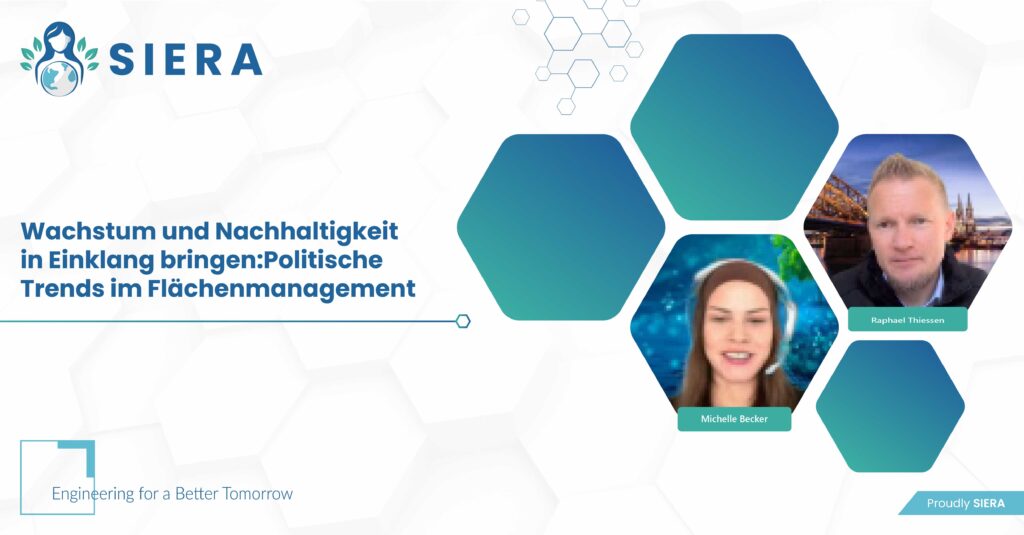
Political Trends in Brownfield Development: Key Takeaways from SIERA’s Webinar
Brownfield development is moving higher on the political, environmental, and urban development agenda across Germany and Europe. In SIERA’s recent webinar, “Political Trends in Brownfields”, Raphael Thiessen explored why these sites are becoming strategically important, what policy trends are driving momentum, and why integrated delivery models are essential to unlock redevelopment at scale.
As a sustainability and environmental engineering ecosystem, SIERA works at the intersection of environmental responsibility, infrastructure, urban development, and technical execution. That positioning makes brownfield revitalization a particularly important topic for SIERA and for stakeholders looking to align growth, land use, and sustainability goals.
Why Brownfields Are Gaining Political and Strategic Relevance
A central theme of the webinar was that brownfields are no longer viewed as niche redevelopment opportunities. They are increasingly seen as a practical response to some of the most urgent land use and climate-related challenges facing Europe.
Across the EU and Germany, policymakers are under growing pressure to:
- Reduce land take and new soil sealing
- Support climate neutrality targets
- Accelerate urban densification
- Enable renewable energy expansion
- Improve land reuse and remediation outcomes
These policy priorities are creating a stronger case for a brownfield-first approach. Rather than continuing to rely on greenfield development, governments and municipalities are looking more closely at the reuse of previously developed land to support housing, infrastructure, economic growth, and decarbonization.
For organizations like SIERA, this shift reinforces the need for technically grounded, sustainability-led redevelopment strategies that can move projects from constraint to implementation.
Brownfields in the European Policy Context
During the webinar, Raphael Thiessen highlighted several major EU policy directions shaping the brownfield landscape.
Key European drivers include:
- The EU Soil Strategy
- Focused on healthier soils by 2050
- Supports the remediation of degraded land
- Encourages better soil quality and land restoration
- The European Green Deal
- Links land use, remediation, and redevelopment to broader climate objectives
- Reinforces the importance of sustainable land management
- Spatial planning priorities
- Increasing emphasis on compact development and land efficiency
- Greater support for reuse over expansion
- Targets related to net land take
- A long-term ambition of no net additional soil sealing by 2050
- Pressure to reduce land consumption and prioritize infill development
- Funding and innovation mechanisms
- Programs such as Horizon Europe can support innovation in redevelopment and environmental solutions, even if they are not direct remediation budgets for individual projects
Together, these policy trends signal that brownfield remediation and reuse are becoming closely tied to climate, land, and sustainability planning across Europe.
What Is Happening in Germany and NRW
The webinar also examined the political discussion in Germany, particularly in North Rhine-Westphalia (NRW), where land pressure is especially visible.
Raphael Thiessen pointed to a number of active tensions shaping the current landscape:
- Economic growth versus land conservation
- Housing and infrastructure expansion versus limited land availability
- Renewable energy buildout versus competing land demands
- Climate neutrality ambitions versus planning complexity
One of the most striking figures shared in the webinar was that NRW consumes around 5.6 hectares per day for settlement and transport uses. That is roughly equivalent to eight football fields every day. Over a decade, that amount of land consumption adds up to an area comparable to the size of Düsseldorf.
Against this backdrop, brownfields are increasingly relevant to policy and planning discussions. Themes gaining traction include:
- A stronger brownfield-first policy shift
- Greater focus on intermunicipal development models
- Discussion around revolving financing mechanisms
- Consideration of tools such as a digital land passport
- Potential support through statewide land recycling funds
This is exactly where SIERA’s integrated expertise matters. Brownfield transformation is not just a planning question. It requires environmental engineering, remediation strategy, technical coordination, and implementation capacity.
Why Brownfields Matter Right Now
The webinar made clear that brownfields are strategically important not only because of policy ambition, but because of the practical realities facing cities, investors, and landowners.
The pressure is growing
Raphael Thiessen outlined several reasons why the urgency is increasing:
- Complex approvals can take 20 to 28 months
- Investor due diligence can add another 6 to 9 months
- Municipalities often cannot carry remediation risk alone
- Land take continues despite climate and planning goals
- Thousands of brownfield and contaminated sites remain underused
In NRW alone, the presentation noted:
- 9,201 brownfield sites identified
- Covering 8,801 hectares
- Approximately 90,000 contaminated sites
- Significant long-term financing needs for remediation and regeneration
These numbers underline a critical point: brownfields are not a marginal issue. They are a large-scale strategic challenge with implications for climate resilience, urban development, industrial transformation, and land efficiency.
At SIERA, this is understood as a cross-disciplinary challenge that requires both engineering depth and coordinated delivery.
Why Brownfield Projects Stall
Another major takeaway from the webinar was that brownfield projects often do not fail because of lack of ambition. They stall because of complexity.
Common barriers include:
- Lengthy approval processes
- Complex redevelopment projects can face prolonged permitting timelines
- Multi-layered regulatory review
- Environmental, contamination, and construction procedures often run in parallel
- Investor due diligence requirements
- ESG, liability, and taxonomy-related reviews add time and caution
- Uncertainty around contamination risks
- Legacy issues can be difficult to quantify early
- Municipal risk overload
- Public actors may not be able to absorb financial and technical uncertainty alone
- Lack of integrated project coordination
- Fragmented delivery models make already difficult projects harder to execute
This is where SIERA’s approach becomes especially relevant. As presented in the webinar, SIERA brings together environmental engineering expertise, sustainability solutions, and implementation-oriented coordination to help address the complexity that often slows brownfield redevelopment.
SIERA’s Role in Advancing Brownfield Transformation
Throughout the webinar, SIERA was positioned not simply as a commentator on brownfield policy, but as an ecosystem built to deliver measurable environmental impact.
SIERA’s approach is grounded in:
- Environmental engineering expertise
- Sustainable infrastructure thinking
- Urban regeneration capability
- Climate and emissions reduction priorities
- Digital and impact-oriented tools
- A vision of Engineering for a Better Tomorrow
This matters because brownfield projects sit at the intersection of multiple environmental and development priorities, including:
- Land restoration
- Climate adaptation
- Circular land use
- Urban resilience
- Sustainable infrastructure
- Healthy soils and ecosystems
SIERA’s model is especially relevant for organizations seeking a more integrated path from site assessment to remediation, redevelopment, and long-term value creation.
Brownfields as Part of a Broader Sustainability Strategy
One of the strongest messages from the webinar was that brownfield redevelopment should not be seen only as a land reuse exercise. It is part of a broader sustainability and decarbonization strategy.
Brownfield revitalization can contribute to:
- Reduced pressure on undeveloped land
- Lower net land consumption
- Smarter urban densification
- Support for climate neutrality goals
- Better alignment between redevelopment and environmental responsibility
For companies, municipalities, and investors, this means brownfields are increasingly relevant not just operationally, but strategically. And for SIERA, they represent an area where environmental responsibility and engineering execution can come together in a meaningful way.
Final Thoughts
SIERA’s webinar on political trends in brownfield development, led by Raphael Thiessen, highlighted a clear market and policy signal: brownfields are becoming a strategic priority across Europe and Germany.
As land pressure intensifies, climate goals tighten, and expectations around sustainable land use continue to rise, the redevelopment of previously used land will play a bigger role in urban and industrial transformation. But turning policy momentum into successful projects requires more than intent. It requires the right technical, environmental, and strategic capabilities.
That is where SIERA adds value. With expertise spanning environmental engineering, sustainable infrastructure, urban development, and impact-driven execution, SIERA helps stakeholders navigate complexity and move from challenge to delivery.
Engineering for a Better Tomorrow.