 EN
EN  DE
DE 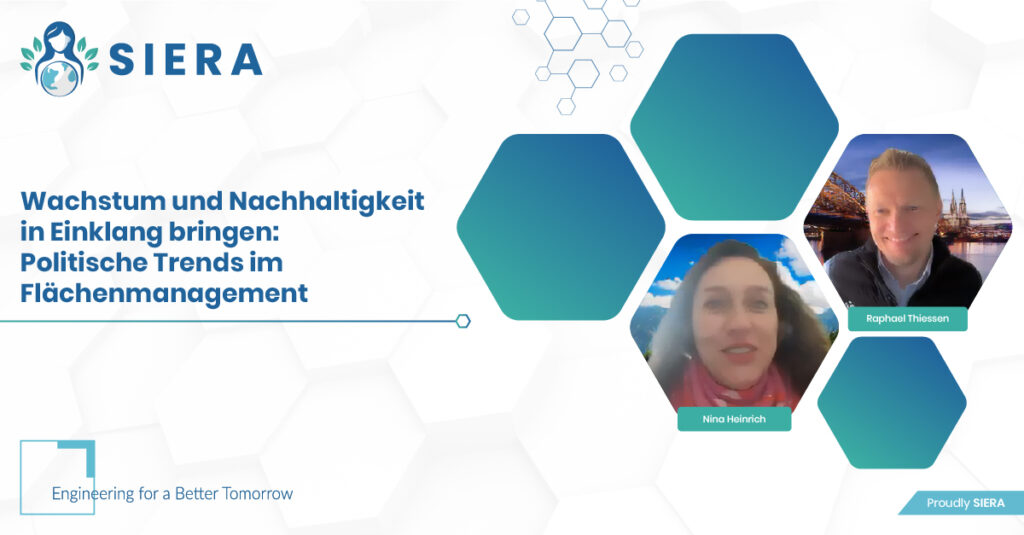
Why Brownfields Are Becoming a Strategic Priority
On 7 April 2026, SIERA hosted its latest SIERA Impact Webinar, titled “Balancing Growth and Sustainability: Political Trends in Land Management”. The session explored how political, regulatory, and market pressures are reshaping the future of brownfield development across Europe and Germany.
The webinar made one thing clear: brownfields are no longer a niche land development topic. They are now central to sustainable growth, climate goals, land-use efficiency, and responsible urban transformation.
As governments, investors, and municipalities face growing pressure to reduce land take, improve soil health, and align projects with ESG and decarbonization goals, the ability to revitalize underused or contaminated land is becoming a strategic capability.
Key Themes from the Webinar
The session focused on five major areas:
- Political trends and land pressure in Europe and Germany
- Why brownfield projects stall
- The integrated solution approach of SIERA
- Why brownfields are strategically important now
- Practical examples of successful brownfield transformation
This combination of policy insight and real-world project experience gave attendees a grounded view of both the challenges and the opportunities ahead.
Brownfields in the Policy Framework: Why the Timing Matters
A major takeaway from the webinar was that brownfield redevelopment is increasingly supported by the broader European policy landscape.
Policy drivers highlighted in the session included:
- EU Soil Strategy
- The European Green Deal
- Spatial planning frameworks
- Funding structures for remediation and redevelopment
- 2030 sustainability targets
- The long-term objective of healthy soils by 2050
- The goal of no net land take / no net new soil sealing by 2050
- The need to reduce soil pollution and improve soil quality
- Accelerating remediation and reuse of degraded land
These policy shifts matter because they move brownfield redevelopment from being a reactive clean-up effort to becoming a proactive sustainability and land management strategy.
In practical terms, brownfield remediation supports:
- Climate objectives
- Efficient land reuse
- Urban resilience
- Reduced pressure on undeveloped land
- Smarter, more sustainable site development
Why Brownfield Projects Still Get Stuck
While the strategic case for redevelopment is growing stronger, the webinar also addressed the reality that many brownfield projects continue to face serious barriers.
Some of the key reasons discussed were:
- Long approval processes
- Complex brownfield projects can take 20 to 28 months
- Multi-layered authority reviews
- Environmental, contamination, and building procedures often run in parallel
- Extended investor due diligence
- Additional review periods of 6 to 9 months
- Growing ESG, liability, and taxonomy requirements
- High uncertainty around contamination risks
- Municipal risk overload
- Remediation risks are often difficult to calculate
- Financial pre-investment burdens
- Upfront costs can be hard to absorb
- Lack of integrated project coordination
This part of the discussion resonated strongly because it reflected a challenge faced across the industry: even when land has high redevelopment potential, fragmented execution models can slow or derail delivery.
The SIERA Perspective: An Integrated Route to Delivery
The webinar also introduced SIERA as a response to this complexity.
According to the presentation, SIERA brings together a group of leading environmental engineering companies with a strong project track record across Germany, focused on:
- Responsibility
- Sustainability
- Measurable impact
Core capabilities highlighted included:
- Brownfield revitalization
- Activating underused land
- Sustainable urban development
- Integrating climate adaptation into redevelopment
- Modern construction approaches
- Maximizing efficiency
- Resource-efficient buildings
- Improving performance and comfort
- Technology
- Enabling real-time monitoring
- Engineering expertise
- Putting environmental engineering at the core of each solution
- Project implementation
- Supporting smooth, high-quality execution
- Making land safe and usable
- Through coordinated technical and environmental expertise
This integrated model is particularly relevant in brownfield projects, where technical, regulatory, financial, and stakeholder risks need to be managed in parallel rather than in isolation.
Real-World Brownfield Transformation Examples
One of the strongest aspects of the webinar was the use of practical project examples to show how brownfields can be successfully repositioned for long-term value.
Examples featured in the presentation included:
- Heilbronn – Industrial Brownfield Revitalization
- Developed in connection with BUGA 2019
- A large-scale site transformation in Heilbronn, Germany
- Demonstrated comprehensive redevelopment of a former industrial brownfield
- Achern – From Former Glassworks Site to Sustainable Urban Quarter
- Showed how a legacy industrial site can be reimagined as a more sustainable, future-ready district
- Emscherland (2020) – Ecological Renaturation Project
- Highlighted the role of biological remediation in enabling sustainable reuse
- Reinforced the environmental value of restoring degraded land
- Neue Meile Lübeck – From Rail Brownfield to Residential Quarter
- Transformation of a former freight rail site into a housing-focused urban development
- A strong example of land recycling in action
- Former Bundeswehr Hospital Rostrup
- Demonstrated the integration of:
- Contamination management
- Waste expertise
- Explosive ordnance expertise
- A compelling case of multidisciplinary remediation and redevelopment
Together, these examples showed that brownfield projects can deliver far more than remediation alone. When approached strategically, they can support:
- New housing and urban development
- Climate-conscious land use
- Environmental improvement
- Long-term community value
- Reduced development pressure on greenfield land
Why This Conversation Matters Now
The webinar underscored a wider market reality: the pressure on land is intensifying, and the expectations placed on developers, municipalities, and investors are changing.
Brownfields sit at the intersection of several urgent priorities:
- Decarbonization
- Soil protection
- ESG performance
- Urban regeneration
- Climate adaptation
- Land-use efficiency
- Regulatory compliance
That makes them a strategic lever for organizations that want to grow responsibly while aligning with emerging policy frameworks.
Speaker Highlight
The webinar featured insights from Raphael Thiessen, focused on brownfield and site development.
For organizations navigating site transformation, contaminated land challenges, or redevelopment strategy, the session offered a clear message: success depends on combining technical expertise, integrated planning, and practical delivery capability.
Final Takeaway
The future of land development will not be defined by expansion alone. It will increasingly be shaped by the ability to unlock value from existing land, restore degraded sites, and deliver redevelopment that is both economically viable and environmentally responsible.
That is why brownfields are moving higher on the strategic agenda.
At SIERA, we believe that sustainable site transformation requires more than compliance. It requires a coordinated approach that connects environmental engineering, risk management, remediation, and implementation to create measurable impact.
Join Our Upcoming Webinars and Events
If you found this topic relevant, we invite you to stay connected with SIERA’s upcoming webinars and events, where we continue to explore the challenges and opportunities shaping environmental performance, land development, ESG, and sustainable transformation.
Why join future SIERA events?
- Hear directly from industry and technical experts
- Stay ahead of regulatory and policy developments
- Discover practical project examples and lessons learned
- Gain insights into integrated environmental and engineering solutions
- Connect with decision-makers working on real-world transformation challenges
Want to stay ahead of the changing landscape in brownfield development, ESG, and environmental strategy?
Join our upcoming SIERA webinars and events to gain practical insights, hear from experts, and explore solutions for your next project.
Engineering for a Better Tomorrow