 EN
EN  DE
DE 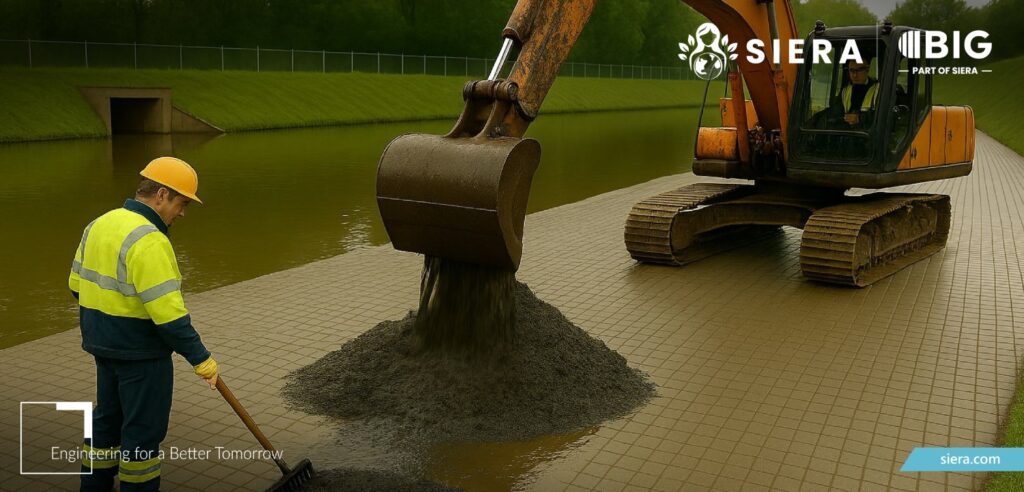
Drainage infrastructure along long-distance roads must function reliably under demanding conditions. A key element of these systems is the rainwater treatment system, which collects and manages surface water from carriageways and associated side facilities. In this context, Prof. Burmeier Ingenieurgesellschaft mbH (BIG), part of SIERA, addresses an important topic in waste management: the qualified disposal of sediments from drainage systems.
Why rainwater treatment systems matter
Rainwater treatment systems are essential components of drainage systems for long-distance roads. They receive surface water from:
- carriageways
- associated side facilities
As water enters the systems:
- suspended solids settle out
- particle-bound pollutants are deposited together with these solids
This means that the resulting sediments and sludges are not simple residues. They require careful technical consideration before disposal.
The challenge of sediment disposal
The disposal of sediments from drainage systems involves more than removal and transport. The main reason lies in the condition of the sludge that accumulates in sedimentation systems.
Main challenge: high water content
A central issue is the high water content of the sludge. This may directly affect disposal because:
- direct delivery to a landfill may not be possible
- the intended disposal route may require prior assessment
- pretreatment may be necessary before disposal
Because of this, disposal must be approached through qualified planning rather than as a routine downstream step.
Why qualified disposal planning is necessary
Before sediments and sludge are disposed of, it must be determined whether the chosen disposal route is suitable. This requires an assessment of the material and of any treatment needs in advance.
Key questions before disposal
Important questions include:
- Does the intended disposal route require sludge dewatering?
- Is pretreatment necessary before disposal?
- Which pretreatment method should be applied?
These questions are essential because the feasibility of the disposal route depends on the actual condition of the sludge.
The role of sludge dewatering
If the sludge contains too much water, direct landfill delivery may be excluded. In such cases, sludge dewatering becomes an important part of the disposal chain.
Why dewatering matters
Sludge dewatering helps determine whether the material can be prepared for the intended disposal route. It also shows how closely technical treatment and disposal planning are linked.
In affiliation with SIERA, Prof. Burmeier Ingenieurgesellschaft mbH (BIG) underlines the importance of assessing:
- whether dewatering is needed
- whether it is technically required for the selected route
- how it supports the pretreatment process
Selecting the right pretreatment method
If pretreatment is required, the procedure must be defined before disposal takes place. This adds another layer of engineering and waste management assessment.
Factors influencing pretreatment choice
The pretreatment method depends on:
- the properties of the sludge
- the intended disposal route
- the acceptance conditions of the destination
This shows that qualified sediment disposal is a structured process rather than a one-step action.
Sediment management as part of waste management
Sediment management in drainage systems is not an isolated operational task. It belongs to a broader waste management process in which infrastructure, environmental aspects, and disposal logistics must be considered together.
What settles in the systems
Within rainwater treatment systems, the following materials accumulate:
- suspended solids
- particle-bound pollutants
- sludge with high water content
These characteristics make technically sound handling and disposal planning essential.
The broader function of rainwater treatment systems
Rainwater treatment systems have a protective function within road infrastructure. They collect and treat surface water from long-distance roads and associated facilities. At the same time, this function generates residual materials that must be managed responsibly.
The sediments and sludges that build up over time are a direct result of the treatment process. Their disposal is therefore a necessary continuation of the system’s environmental function.
A structured approach to qualified disposal
From a waste management perspective, qualified disposal means reviewing the disposal route before action is taken. It is not enough to assume that landfill disposal is possible. Instead, the material must be assessed in relation to:
- its water content
- the technical requirements of the intended destination
- the need for sludge dewatering
- the necessary pretreatment method
This approach helps avoid unsuitable disposal planning and supports a more reliable and compliant process.
Why this topic is important
The technical significance of this issue is clear. Sludge produced in sedimentation systems cannot always be disposed of directly. High water content may require prior conditioning through dewatering. Once this has been established, the next step is to define the suitable pretreatment method.
Within the SIERA network, Prof. Burmeier Ingenieurgesellschaft mbH (BIG) shows how this process connects:
- the operational realities of drainage infrastructure
- the practical requirements of waste management
- the technical assessment of disposal routes
The qualified disposal of sediments from drainage systems requires more than removal and transport. Rainwater treatment systems collect surface water from long-distance roads and associated side facilities. In doing so, they also collect suspended solids and particle-bound pollutants. The resulting sludge often has a high water content, which may prevent direct landfill delivery.
Before disposal, it is therefore necessary to determine:
- whether sludge dewatering is required
- which pretreatment method should be used
- whether the intended disposal route is suitable
Prof. Burmeier Ingenieurgesellschaft mbH (BIG), part of SIERA, highlights how qualified disposal planning supports responsible waste management in infrastructure systems.
To explore more, visit the website of SIERA and Prof. Burmeier Ingenieurgesellschaft mbH (BIG).
Engineering for a Better Tomorrow.