 EN
EN  DE
DE 
Initial status report (AZB) for a gas-fired power plant in Hesse
As part of the approval of a planned combined heat and power plant in Hesse, a baseline report (AZB) was prepared. This report is a central component of the approval procedure under immission control law and serves to systematically document the condition of soil and groundwater before the construction or significant modification of a plant.
MuP Umwelttechnik GmbH – a member of the SIERA Alliance, based in Heidelberg, accompanies such procedures in a technically sound and practical manner. The aim is to identify environmental risks at an early stage, to reliably meet legal requirements and to ensure long-term precautions for people and the environment – in line with Engineering For a Better Tomorrow.
What is a baseline report (AZB)?
The initial status report documents the actual condition of soil and groundwater on a plant site before the start of plant operation. It thus forms the technical and legal basis for:
- to be able to clearly detect subsequent changes or impurities
- Systematically monitor environmental pollution
- enable proper recycling in the event of plant decommissioning
The obligation to draw up an AZB arises in particular from the Federal Immission Control Act (BImSchG) and the Industrial Emissions Directive (IED Directive). Both sets of regulations pursue the goal of protecting environmental media in the long term and holding operators accountable in the long term.
Legal significance of the AZB in the approval process
A central element of the initial state report is its preservation of evidence function. According to § 5 (4) BImSchG, after a plant has been decommissioned, there is an obligation to restore the original state of soil and groundwater if there is significant pollution.
The AZB serves as a binding reference state. For plant operators, this means:
- Clear demarcation between contaminated sites and operational entries
- Increased legal certainty vis-à-vis licensing and supervisory authorities
- Transparent and traceable documentation over the entire system life cycle
Focus on relevant hazardous substances (rgS)
As part of the preparation of the AZB, so-called relevant hazardous substances (rgS) are identified. These can arise from operating materials used in the future and potentially end up in soil or groundwater.
Possible entry causes include:
- Technical defects or leaks
- Accidents in plant operation
- improper storage or handling
The early identification and evaluation of these substances is crucial in order to determine suitable precautionary measures and to avoid environmental pollution in the long term.
The three phases of AZB creation
The preparation of a baseline report is structured and is divided into three phases that build on each other.
Phase 1: Concept for the initial status report
In the first phase, an AZB concept will be developed. This includes:
- the requirement test
- the identification of relevant hazardous substances
- the assessment of the substance risk
- the development of an investigation concept
The aim is to determine the type and scope of the necessary examinations in a technically sound manner.
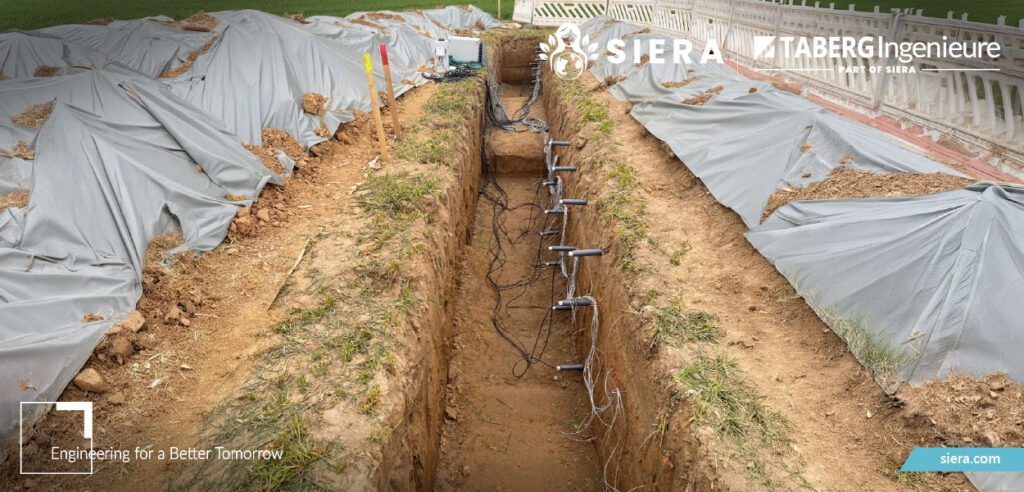
Phase 2: Site investigations of soil and groundwater
The site investigations are carried out on the basis of the concept. These include:
- Soil investigations
- Groundwater investigations
- Sampling and laboratory analysis evaluations
The results are systematically documented and compiled in the baseline report. The report is an essential part of the permit application and reflects the reference status before the plant was commissioned.
Phase 3: Monitoring during the operational phase
During the operating phase, the soil and groundwater condition is regularly monitored by means of periodic status checks.
This continuous monitoring enables:
- Early identification of changes
- Timely countermeasures in the event of abnormalities
- Long-term protection of the environment and resources
Bedeutung des AZB für Anlagenbetreiber
Ein fachgerecht erstellter Ausgangszustandsbericht bietet zahlreiche Vorteile:
- rechtliche Absicherung über den gesamten Lebenszyklus der Anlage
- Transparent communication with authorities
- Structured environmental precautions
- a reliable basis for the obligation to return in the event of decommissioning
Orientation on recognized guidelines
The preparation of the initial state report is based, among other things, on the
LABO working aid for the preparation of initial state reports.
This ensures that methodology, evaluation and documentation are uniform, comprehensible and legally secure throughout Germany.
Conclusion
The baseline report is a key instrument for proactive environmental protection. It creates transparency, legal certainty, and a reliable basis for the sustainable operation of facilities requiring permits.
Particularly for energy generation facilities, the baseline report enables clear documentation of the environmental status – from planning through operation to decommissioning.
Are you planning a facility requiring approval or need support in preparing a Baseline Condition Report?
MuP Umwelttechnik GmbH — a member of the SIERA Alliance — supports you with technical expertise, practical solutions, and a clear focus on environmental and legal requirements.