 EN
EN  DE
DE 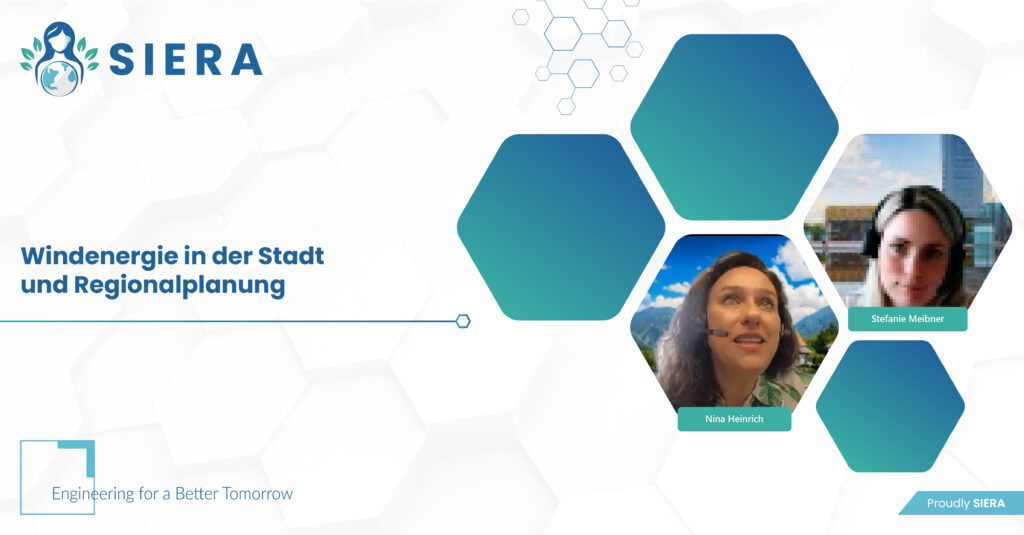
As part of its ongoing commitment to practical, future-focused sustainability dialogue, SIERA recently hosted an Impact Webinar on Wind Energy in Urban and Regional Planning. The session brought together critical perspectives on how municipalities, planners, and decision-makers can approach wind energy development in a way that is strategic, compliant, and aligned with long-term climate goals.
Led by Stefanie Meissner, the webinar explored why wind energy must be treated not as an isolated project, but as a spatially significant infrastructure measure that requires coordination across planning, environmental review, land use, access, and permitting processes.
Through webinars like this, SIERA continues to support organisations and public-sector stakeholders with expert-led insights that connect sustainability, regulation, and implementation.
Why Wind Energy Planning Matters Now
Wind energy plays an increasingly important role in the transition to a lower-carbon economy. Yet successful implementation depends on more than identifying available land. As highlighted during the webinar, wind energy planning sits at the intersection of climate action, spatial planning, legal requirements, and local development priorities.
The discussion emphasized several reasons why this topic is especially relevant for cities and regions today:
- Supporting climate protection goals
- Reducing CO₂ emissions
- Strengthening energy security
- Avoiding land-use conflicts
- Enabling more efficient use of space
This broader planning perspective is essential. SIERA regularly addresses these interconnected challenges through its webinar series, helping stakeholders move from high-level ambition to practical action.
Key Themes Covered in the Webinar
The webinar agenda focused on the main dimensions of sustainable wind energy planning. Each section reflected the need for an integrated approach that balances regulatory compliance, development feasibility, and regional priorities.
- Technical and Strategic Relevance
One of the central messages of the session was that wind energy is a spatially impactful infrastructure measure. This means it affects not only energy generation, but also broader regional development patterns, environmental considerations, and community planning outcomes.
Rather than treating wind projects as stand-alone developments, planners must assess how they fit into larger territorial strategies. This kind of systems thinking is increasingly important in sustainability and infrastructure planning, and it is an area where SIERA continues to provide value through knowledge-sharing and expert engagement.
- Planning Law and the Targeted Steering of Land
The webinar also addressed the importance of planning-law foundations and the targeted steering of land use. For municipalities and regional authorities, legal and spatial planning frameworks are critical for guiding development in a way that is transparent, defensible, and aligned with public objectives.
This includes understanding how land can be designated, assessed, and managed to support wind energy while reducing friction with other land uses. Through sessions like this, SIERA highlights how regulatory clarity can strengthen sustainability outcomes rather than hinder them.
- Planning Challenges
Another major discussion point involved the practical planning challenges associated with wind energy projects. These challenges can arise across multiple stages, including:
- Site selection
- Environmental assessment
- Infrastructure access and development
- Permitting and approvals
- Coordination across planning stakeholders
The webinar underscored that these issues are interconnected. Progress in one area often depends on decisions made in another. This reinforces the importance of structured planning processes and informed decision-making, both of which are central to the broader sustainability support ecosystem that SIERA promotes.
- Opportunities for Cities and Municipalities
Despite the complexity, the session also made clear that wind energy planning presents significant opportunities for local and regional authorities. When approached strategically, it can help municipalities:
- Advance local climate action efforts
- Improve long-term energy resilience
- Use land more efficiently
- Minimize avoidable land-use conflicts
- Contribute to broader decarbonization pathways
For public-sector stakeholders, these are not just environmental opportunities, they are also planning and governance opportunities. SIERA continues to spotlight these practical dimensions through content and events designed to support sustainable transformation.
Speaker Spotlight: Stefanie Meissner
A key strength of the webinar was the expertise brought by Stefanie Meissner, who guided attendees through the planning relevance, legal context, and implementation considerations surrounding wind energy development.
Her contribution helped frame wind energy not simply as a technical or environmental issue, but as a planning matter that requires coordination, structure, and long-term thinking. This expert perspective reflects the value of the SIERA webinar format: bringing knowledgeable voices into focused conversations that help organizations and institutions better understand evolving sustainability topics.
The Role of SIERA in Sustainability Dialogue
At SIERA, webinars are more than thought leadership sessions, they are part of a broader effort to help organisations navigate sustainability with greater clarity and confidence.
By hosting focused discussions on issues such as urban planning, decarbonization, ESG, and environmental reporting, SIERA creates space for stakeholders to explore complex topics in a practical and informed way. The June 23 webinar is a strong example of this approach, connecting policy, planning, and sustainability in a format designed to support real-world understanding.
Final Takeaways from the Webinar
The webinar highlighted an important reality: effective wind energy development depends on integrated planning. It requires alignment between land use, environmental review, infrastructure considerations, legal frameworks, and broader regional goals.
Key takeaways include:
- Wind energy must be treated as a major spatial planning issue, not a stand-alone project
- Legal and planning frameworks play a vital role in guiding responsible development
- Municipalities have an opportunity to use wind planning as part of wider climate and energy strategies
- Coordinated, sustainability-focused planning can help reduce conflicts and improve implementation outcomes
Through events like this, SIERA continues to help stakeholders engage with the practical dimensions of sustainable development in a meaningful way.
Learn More from SIERA
To explore more expert-led sustainability insights, visit SIERA.
For organizations, municipalities, and professionals working at the intersection of planning, climate action, and environmental strategy, SIERA remains a valuable source of guidance and discussion on the topics shaping a more sustainable future.
Engineering for a Better Tomorrow.