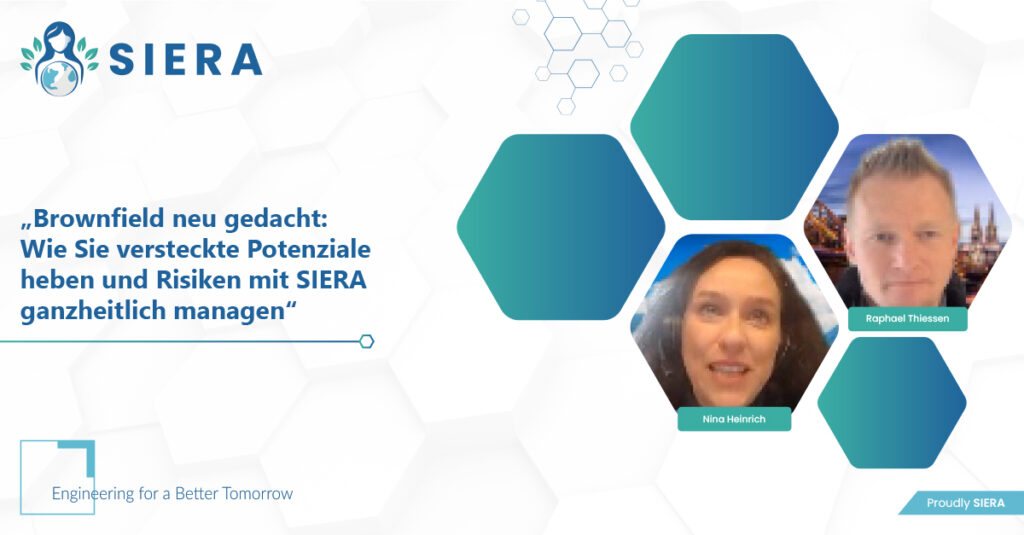
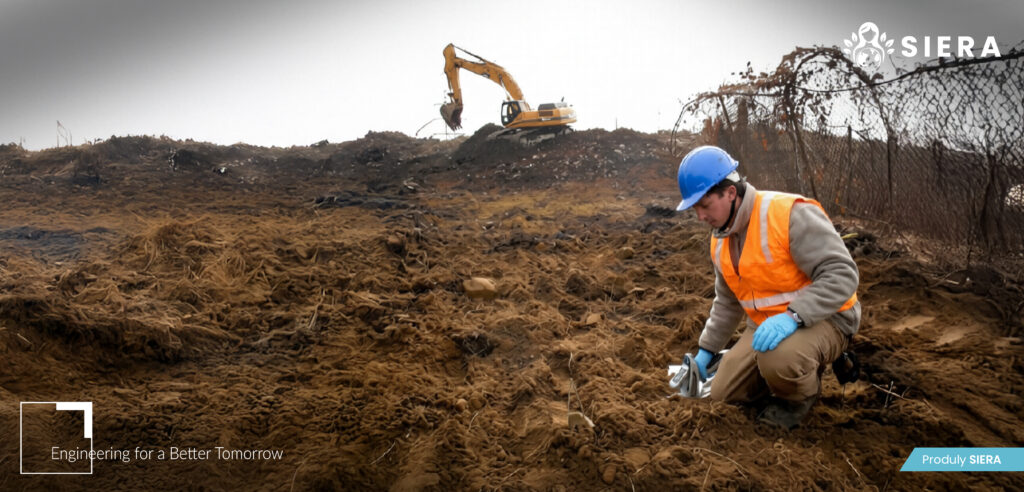
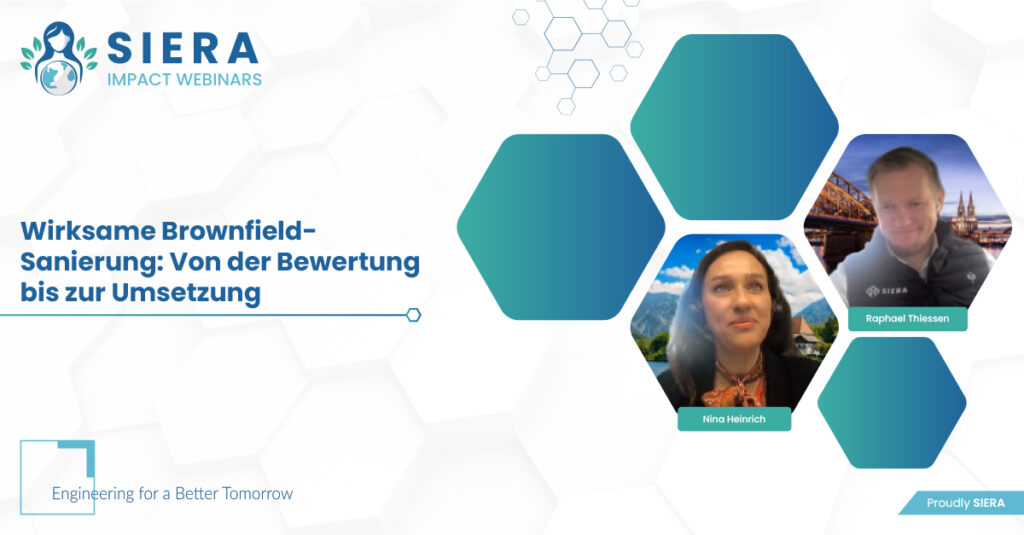
On 24 February 2026, SIERA hosted its latest SIERA Impact Webinar, bringing together experts from across the alliance to address one of Europe’s most pressing environmental and urban development challenges: brownfield revitalization.
Under the theme “Brownfield Reimagined – From Complexity to Clarity”, the session explored how integrated environmental engineering, digital tools, ESG alignment, and innovative financing can transform contaminated and underutilized land into long-term sustainable value.
The SIERA Impact Webinars are designed to bridge strategy, regulation, finance, and engineering practice. They reflect the alliance’s mission: Engineering for a Better Tomorrow. This session demonstrated why brownfields are no longer a niche topic, they are central to Europe’s climate, land-use, and urban resilience agenda.
Why Brownfields Are Now Strategic Infrastructure
Brownfields are no longer peripheral development sites. They are becoming a strategic resource for climate-neutral growth.
As highlighted during the webinar presentation
150,000–176,000 hectares of unused or underutilized land exist in Germany alone
Land sealing continues at significant rates each year
Renewable energy expansion requires land—often available on brownfield sites
The message was clear: “The end of greenfield is real.” Future development must prioritize regeneration over expansion.
Brownfields support:
Land-use efficiency
Renewable energy infrastructure
Urban densification strategies
Biodiversity restoration
Climate mitigation and adaptation
In this context, brownfield development becomes environmental engineering in its most holistic form.
The Regulatory and Financial Drivers in Europe
A key segment of the webinar focused on the regulatory and financial landscape accelerating brownfield redevelopment across Europe.
Policy Drivers
EU Climate Neutrality Framework
Mission Soil 2030
Horizon Europe Living Labs (2025 calls)
Cohesion and Regional Development Funds
LIFE Programme for Environment & Climate
Financial Instruments
Brownfield remediation is increasingly taxonomy-aligned and financeable, including:
EU Public Funding (ERDF, LIFE, InvestEU)
Green Bonds (EU Green Bond Standard)
Sustainability-Linked Loans
SFDR Article 8/9 investment strategies
The webinar emphasized that environmental engineering today must integrate technical feasibility with financial structuring and ESG compliance. Without this integration, projects stall during due diligence or permitting.
The Reality of Brownfield Development
Despite the opportunity, brownfield redevelopment remains complex.
Permitting timelines can extend to 20–28 months.
Investor due diligence often requires 6–9 months.
Municipalities frequently lack the capacity to carry remediation risks alone.
In regions like North Rhine-Westphalia:
Approximately 90,000 contaminated sites are recorded
Thousands of hectares of brownfields remain underutilized
Financing demand reaches hundreds of millions of euros over a decade
This reality underscores why fragmented project management is no longer sufficient.
SIERA’s Integrated End-to-End Approach
During the webinar, Raphael Thiessen, Brownfield & Site Development expert within the SIERA Alliance, outlined how SIERA connects environmental engineering expertise with capital and implementation capability.
SIERA stands for Sustainability, Impact, Environment, Responsibility, Alliance and operates as an integrated environmental engineering network across 14 engineering firms.
SIERA Core Competence Areas
Environmental Engineering Area
Integrated Brownfield Relevance
Land & Brownfield Management
Site assessment, remediation, redevelopment
Climate & ESG
Strategy, reporting, taxonomy alignment
Energy & Asset Management
Low-carbon energy concepts
Water & Flood Management
Risk modeling and mitigation
Urban Planning & Engineering
Infrastructure integration
Circular Economy & Impact Technology
Resource efficiency and digital monitoring
The webinar emphasized thatsuccessful brownfield transformation requires:
Early-stage environmental due diligence
Liability clarification
Best-practice remediation planning
Waste and material flow optimization
Post-remediation monitoring
Regulatory and ESG alignment
This structured framework reduces uncertainty and increases investor confidence.
Municipalities as Key Actors
A strong focus of the session was the role of municipalities.
Cities are under pressure to:
Increase density by 10–20%
Reduce new land sealing
Enable renewable infrastructure
Secure sustainable financing
Yet municipalities often lack integrated technical and financial capacity.
This is where SIERA member companies, operating as part of the SIERA Alliance, combine environmental engineering, infrastructure planning, ESG advisory, water management, ecosystem restoration, and circular economy expertise under one coordinated structure.
The result is not just remediation but systemic urban transformation.
Brownfield Reimagined: From Liability to Strategic Asset
One of the central messages of the webinar was the reframing of brownfields:
From:
Environmental liability
Financial uncertainty
Permitting complexity
To:
Renewable energy hubs
Climate-neutral districts
Mixed-use sustainable urban quarters
Biodiversity and ecosystem restoration sites
Brownfields are no longer a constraint—they are a platform for impact-driven investment.
When aligned with EU Taxonomy requirements and ESG criteria, remediation projects become investable, measurable, and scalable.
The Broader Vision: Engineering for a Better Tomorrow
The SIERA Impact Webinars are more than knowledge sessions. They are strategic dialogues about how environmental engineering must evolve.
The session demonstrated:
Brownfield regeneration is central to Europe’s decarbonization strategy
Integrated engineering reduces project risk
ESG and finance must be embedded from day one
Municipalities need structured, end-to-end partners
SIERA’s mission, to connect expertise and capital for scalable sustainability projects was evident throughout the discussion.
By aligning environmental engineering precision with financial and regulatory clarity, SIERAtransforms complexity into structured execution.
Key Takeaways from the Webinar
Brownfields are a critical resource for achieving climate neutrality.
EU policy and green finance frameworks actively support redevelopment.
Permitting and liability complexity require integrated governance.
ESG alignment and EU Taxonomy compliance enhance investability.
End-to-end engineering coordination is essential for delivery certainty.
Continue the Conversation
The SIERA Impact Webinars bring together experts of the SIERA Alliance to explore real-world solutions in environmental engineering, climate resilience, urban sustainability, and ESG transformation.
If your organization is navigating:

 EN
EN  DE
DE